Skip to content
Coaxial cables

RG 213/U

Construction and cross-section

RG 213/U is a thick coaxial cable with a characteristic impedance of 50 ohms: a stranded center conductor of seven bare copper wires, a solid polyethylene dielectric, a braided shield of bare copper and a black PVC jacket.

Key data

Characteristic impedance
50 Ω
Outer diameter
10.3 mm
Layers
4
The camera travels around the cable – RG 213 – in the photo studio on a light backdropVideo: Cable Creations.

Every cable is the answer to a task.

01Jacket
The construction

Layer by layer, to scale.

Longer 50-ohm runs and higher transmit power, for example as an antenna feed line in radio systems. Compared with RG 58 the cable is thicker and stiffer, and it attenuates the signal less.

4 layers

inside

  1. Bare copper

    Ø 2.26 mm

    7 wires

  2. Solid polyethylene (PE)

    Ø over this layer 7.24 mm

  3. Bare copper

    Single wire Ø 0.18 mmassumed

  4. PVC

outsideØ 10.3 mm

“Assumed” means: the value does not come from a datasheet but is a usual value or one chosen from a reference.

Cross-section

To scale
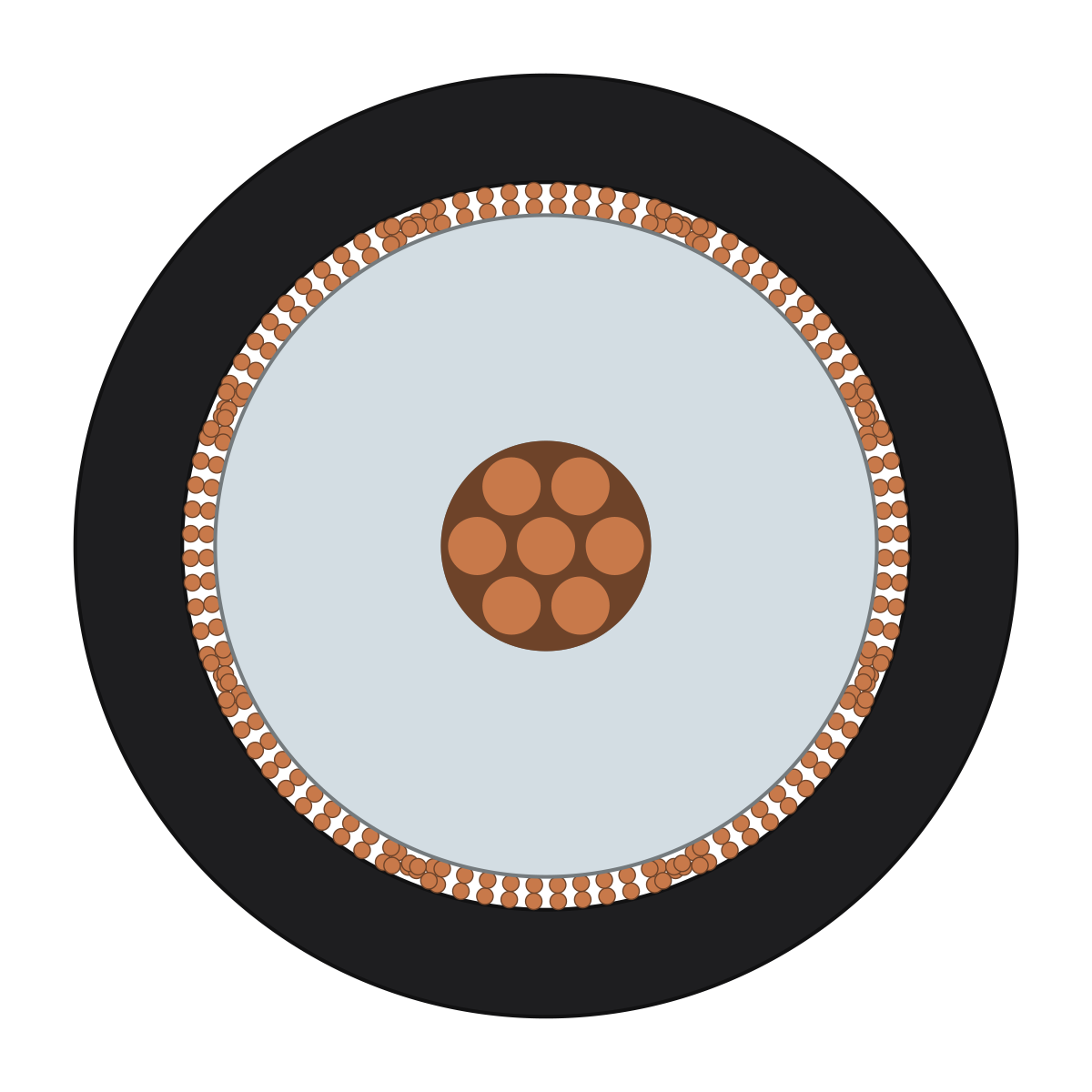
Cross-section of a RG 213/U cable: all layers from the conductor to the jacket, to scaleØ 10.3 mm
Cross-section of RG 213/U, computed to scale from the construction data.Picture: Cable Creations. Free to use with a link to this page as the credit.
  1. Outer diameter

    10.3 mm

  2. Dielectric

    7.24 mm

  3. Center conductor, stranded

    2.26 mm

Side view of a RG 213/U cable, stripped on the right down to the conductor
RG 213/U in side view.Picture: Cable Creations. Free to use with a link to this page as the credit.

To look for yourself, take it in your hand.

02Braided shield
The model

Turn, zoom, hide layers.

RG 213/U as a 3D model, from the same data as every picture on this page.

RG 213/U as a 3D model

Loads the model (0.1 MB)

3D model3D model · 134 kB

The model becomes every picture and every film.

03Dielectric
The pictures

One model, every picture.

Taken apart, up close, where it is used: pick a picture or a film of RG 213/U. All of them are computed, not photographed, and say nothing about what the cable is approved for.

3D render: Three-quarter view of the stripped end – RG 213 coaxial cable with a black jacket, copper braid, white insulation and a stranded copper conductor, in the photo studio on a light backdrop, print “Cable Creations”
Three-quarter view of the stripped end – RG 213 – in the photo studio on a light backdropPicture: Cable Creations. Free to use with a link to this page as the credit.
3D render: Detail of the stripped layers – RG 213 coaxial cable with a black jacket, copper braid, white insulation and a stranded copper conductor, in the photo studio on a light backdrop, print “Cable Creations”
Detail of the stripped layers – RG 213 – in the photo studio on a light backdropPicture: Cable Creations. Free to use with a link to this page as the credit.
3D render: Close-up of the print on the jacket – RG 213 coaxial cable with a black jacket, copper braid, white insulation and a stranded copper conductor, in the photo studio on a light backdrop, print “Cable Creations”
Close-up of the print on the jacket – RG 213 – in the photo studio on a light backdropPicture: Cable Creations. Free to use with a link to this page as the credit.
3D render: Three-quarter view of the stripped end – RG 213 coaxial cable with a black jacket, copper braid, white insulation and a stranded copper conductor, in daylight on grass, print “Cable Creations”
Three-quarter view of the stripped end – RG 213 – in daylight on grassPicture: Cable Creations. Free to use with a link to this page as the credit.
3D animation: Materialization: the cable forms layer by layer from liquid metal – RG 213 coaxial cable with a black jacket, copper braid, white insulation and a stranded copper conductor, in the photo studio on a light backdrop, print “Cable Creations”
Materialization: the cable forms layer by layer from liquid metal – RG 213 – in the photo studio on a light backdrop0:07Video: Cable Creations.
Pick a picture or a film

That leaves the question of what the jacket says.

04Center conductor
The name

What the name says.

“RG” stands for “Radio Guide” and comes from a US military designation system for radio-frequency cables. The number is a serial number: it says nothing about diameter or characteristic impedance. A letter after the number marks a version of the type, and the suffix “/U” marks general use.

The printSchematic view of the jacket with the type designation.

Sources and assumptions

Center conductor, dielectric, outer diameter and the materials of shield and jacket follow the Belden 8267 datasheet. The wire diameter of the braid, its number of wires and its lay length are assumed.

Your whole range can look like this.

Pricing

Our prices are public.

See pricing

What each package includes, what an image costs as an extra, and how your cables get into the portal.